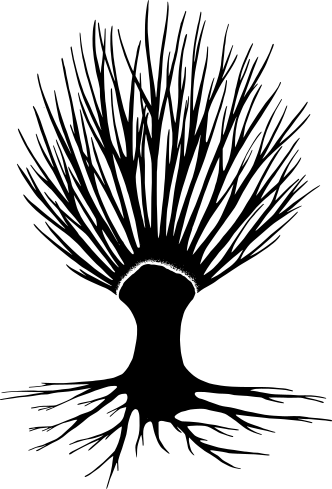
(a papermaker’s philosophy)
Trees are old. They have been adapting to life on our planet for over 370 million years. With that in mind, it is perhaps not so surprising that within many indigenous communities, trees were understood as beings of wisdom. People turned to them for counsel, support, inspiration and ritual.
Much has changed since. With colonization, land enclosure and the social construction of the modern human being, the indigenous relationality with the trees got lost. Or forgotten, rather, as ‘we’ isolated ourselves as the only intelligent species.
How to connect with a tree, how to recognize their intelligence and share in one another’s knowledge, if we don’t remember how to speak a shared language?
I am not a romanticist. I don’t long for an imaginary past where everything was supposedly more whole or more beautiful. But I do feel called to the trees, and urgently so, in this time of genocide and ecological destruction. I find myself turning to them for solace; for silence; for a listening ear; for the wisdom and inspiration to move forward.
The trees know how to create. And they know it well. They’ve learned not merely to adapt, but to grow together, to support one another, to transform when needed, to grieve the losses.
I have come to understand papermaking, with its slow and repetitive gestures, the long time spent with the body of the tree; being in touch, hand against bark, skin against skin; to be a way of building again a form of kinship and community between vegetal and human.
My practice inhabits a certain mode, or posture, of papermaking. Standing in the lineage of many craftspeople before and after, I take up certain things of that lineage, practice them, in my way, and carry them into the future. The love for handwork. The commitment to the non-lingual. Learning through touch, pressure, movement, repetition. The deep and embodied understanding that what we call ‘material’ is always singular and alive; has its unique and often unexpected forces, its own history.
Yet I have also deliberately broken with other inheritances of that lineage. The quest for mastery. The ableism. The narrative that centers the human as some kind of all-creating homo faber. The dominating maleness and whiteness of what has long counted as craft, and who was allowed to practice.
I’ve long been looking for words to describe how I feel with the trees as a papermaker, and stumbled upon the words that really resonated not in the realms of craft theory but in a science fiction novel.
When Teek captain Xiala is learning the lost way of her ancestors co-creating with their mother, the ocean, this is what she comes to see:
“In and out. High and low. It was a constant balancing. After all, such immense and varied power could not be controlled. It existed in reciprocity. Taking and receiving, a tidal ebb and flow. She had only to find a way to float in it, to hold the power in her open hand and let it flow through her fingers at the same time.
Teanni had been right about one thing.
Before, when Xiala had tried to drown herself, she had been trying too hard. The sea did not want her to surrender. It wanted her cooperation. It was a state of mutuality, not submission.”
(from: Mirrored Heavens by Rebecca Roanhorse, emphasis added)
A state of mutuality. Aye!
What would it mean, to be in a state of mutuality with the trees and plants that inhabit earth with us?
Quite clearly, it would mean to stop controlling and dominating them, not to force our living ‘environment’ any longer into the shape of our own desires. Yet neither, I think, would it mean to surrender to ‘the natural world’, to give our own power away and submit all that is or can become to non-human forces.
Submission and domination are opposite positions within the same structure. One side controls, often violently, the other side yields, often because it is violently forced to. Changing positions does not change the structure of power. Moving from domination to submission means the structure of the dynamic remains the same.
A state of mutuality, it seems, asks for something else altogether. A different shape of relation; one that doesn’t rely on control, in either direction.
To me, as a queer papermaker, to practice such a state implies I accept there are no solid paths nor identities. There is no fixed binary or clear dividing line between the tree and myself, between human and vegetal attention.
Making paper as such, I am no longer sure of who did or created what; who initiated that red willow fiber swirled up and looking as it does in the middle of the paper body; much like in one of those rare but true conversations with an equal, where you end up articulating the things that neither of you would ever have been able to express on their own, and yet you cannot really define where the change of perspective originated but within the process of the interaction.
What then, I’d like us to wonder, is paper?